Garden vision
A garden for growing, learning and habitat
An accessible garden pairing native Pennsylvania pollinator meadow with edible demonstration beds, an outdoor classroom, a rain garden, compost and rainwater collection. It would start as a 0.5–1 acre pilot and could grow only if Lehigh sees value and suitable land exists.
What the garden would offer
For people
- An accessible loop path, raised beds at comfortable heights, quiet seating and shade.
- An outdoor classroom for courses, workshops and visiting groups.
- Edible demonstration beds where students can learn to grow food.
- A water point with a bottle filler, if a water connection can be confirmed.
For nature
- Native Pennsylvania pollinator meadow in place of mown lawn.
- A rain garden that slows runoff, and rainwater collection for drip irrigation.
- Compost that turns garden waste back into soil.
- No lighting by default, so night skies and wildlife are undisturbed.
The philosophy behind it
- Simpler
- Fewer steps, easy to run and easy to maintain.
- More accessible
- Physically, with accessible routes and raised beds; financially; and with clear information.
- Less wasteful
- Careful with materials, water, energy, food and land.
- Affordable or free where practical
- Aim to be free to visit and use, subject to Lehigh’s access rules, with real costs and who pays stated openly once they are known.
Added after the plan PDF: a later idea for discussion, not a commitment. One long-term aim, not a promise: a future where money matters much less, and what counts is people and the work they do together.
An illustrative view
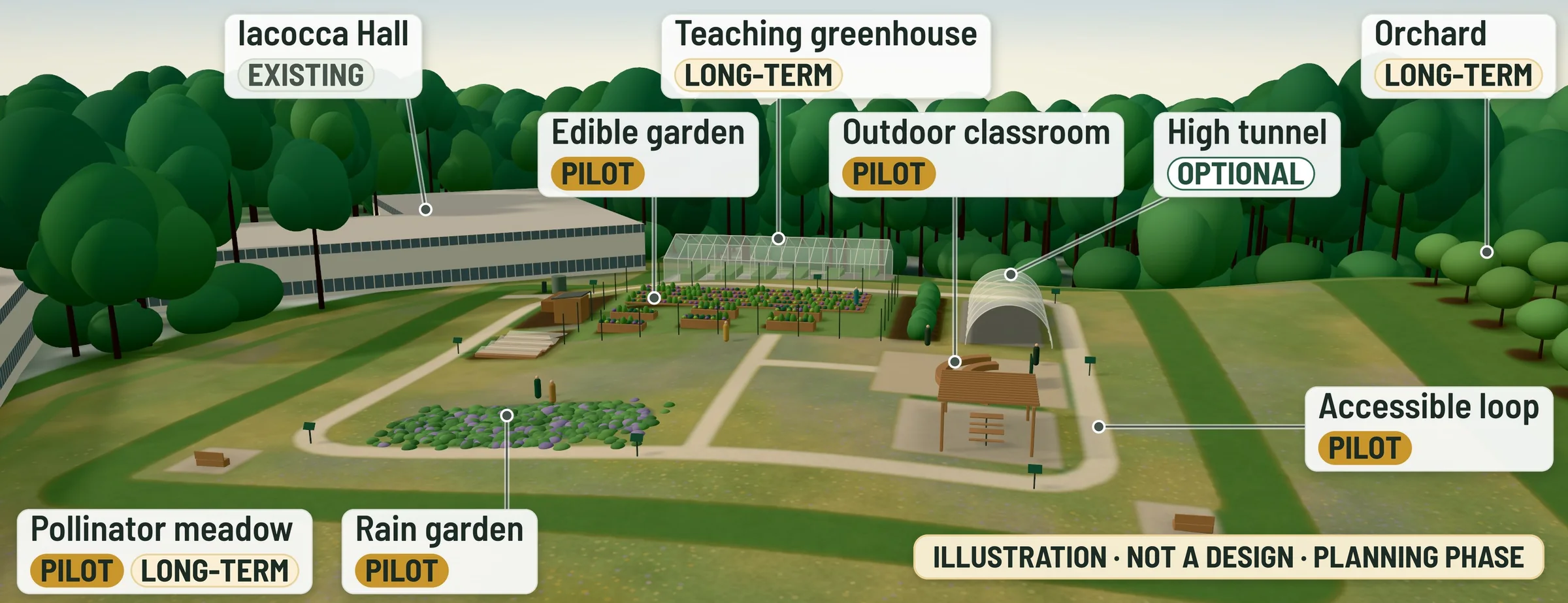
Credits: Terrain: USGS elevation. Trees: from USDA NAIP 2017 imagery via USGS. Buildings: © OpenStreetMap contributors (ODbL), Microsoft ML Buildings, via Overture Maps.
Text description of this image
The view looks north across the East Summit Lawn, with Iacocca Hall at the left as simplified grey massing and forest all around. A pale accessible loop path, about 6 ft wide (preliminary), encloses the pilot garden, and a mown trail circles the lawn.
White cards name the features, each with a chip. Pilot: the edible garden with accessible raised beds, the outdoor classroom with curved benches, the rain garden and the accessible loop. Pilot and long-term: the pollinator meadow in the foreground. Optional: the high tunnel, a white hoop house. Long-term: the teaching greenhouse, a glass house behind the beds, and the orchard, rows of fruit trees at the right. Existing: Iacocca Hall.
Shown but not labeled: the compost and tool yard and the water point (pilot), and the shaded picnic pergola, seed nursery and native berry hedge (optional). A chip at the bottom right reads “Illustration · not a design · planning phase”.
Why it matters
Sustainability
- Native meadow and hedgerow habitat for pollinators and birds, building on the 2021 meadow pilot Lehigh has reported.
- Less mowing where lawn becomes meadow.
- The rain garden and cistern slow runoff and reuse rainwater for drip irrigation.
- Compost closes a small food-waste loop. There is no lighting by default, so night skies and wildlife are undisturbed.
Learning & community
- Outdoor classroom beside Iacocca Hall’s teaching and lab spaces.
- Student-run biodiversity monitoring: pollinator counts, bird surveys, iNaturalist.
- Food-growing practice, volunteer days and interpretive signs for visitors.
- Four-season use: high-tunnel growing, standing seed heads and winter bird habitat.
These benefits are described qualitatively; none has been measured.
Reuse it anywhere
Planning phase · a later idea, not in the plan PDF
What another place could copy
- The method: study areas found from public data, a small pilot first, and every condition met before anything grows.
- The templates and checklists: the site study, the food-safety steps, the role quick guides and the go-live list.
- Place details kept in one settings file, so a copy changes names and places in one spot.
- Templates carry no people, contacts or private data.
What stays local and must be checked there
- Who owns the land, and their written permission
- Permits and laws, including food-safety rules
- Climate, soil and native plants
- Language, currency and units
A copy would start as an idea, with every permission still to be asked for.
Beyond Bethlehem. The aim is that the same method could help start gardens on other campuses and in other towns in Pennsylvania, across the US, for example in the Midwest, and around the world. This is an aim, not a plan or a promise.
What this is not
Not a design or a survey
Plans and renderings are illustrations from public data. Any real design would need a survey, utility locating, soil tests, an accessibility review and university processes.
No tree removal
The plan uses existing open lawn only. It does not propose clearing any of the surrounding woodland.
No museum or transit pieces
Ideas for an underground museum or transit station are speculative. No supporting source was found, so they are part of neither the pilot nor the long-term vision.